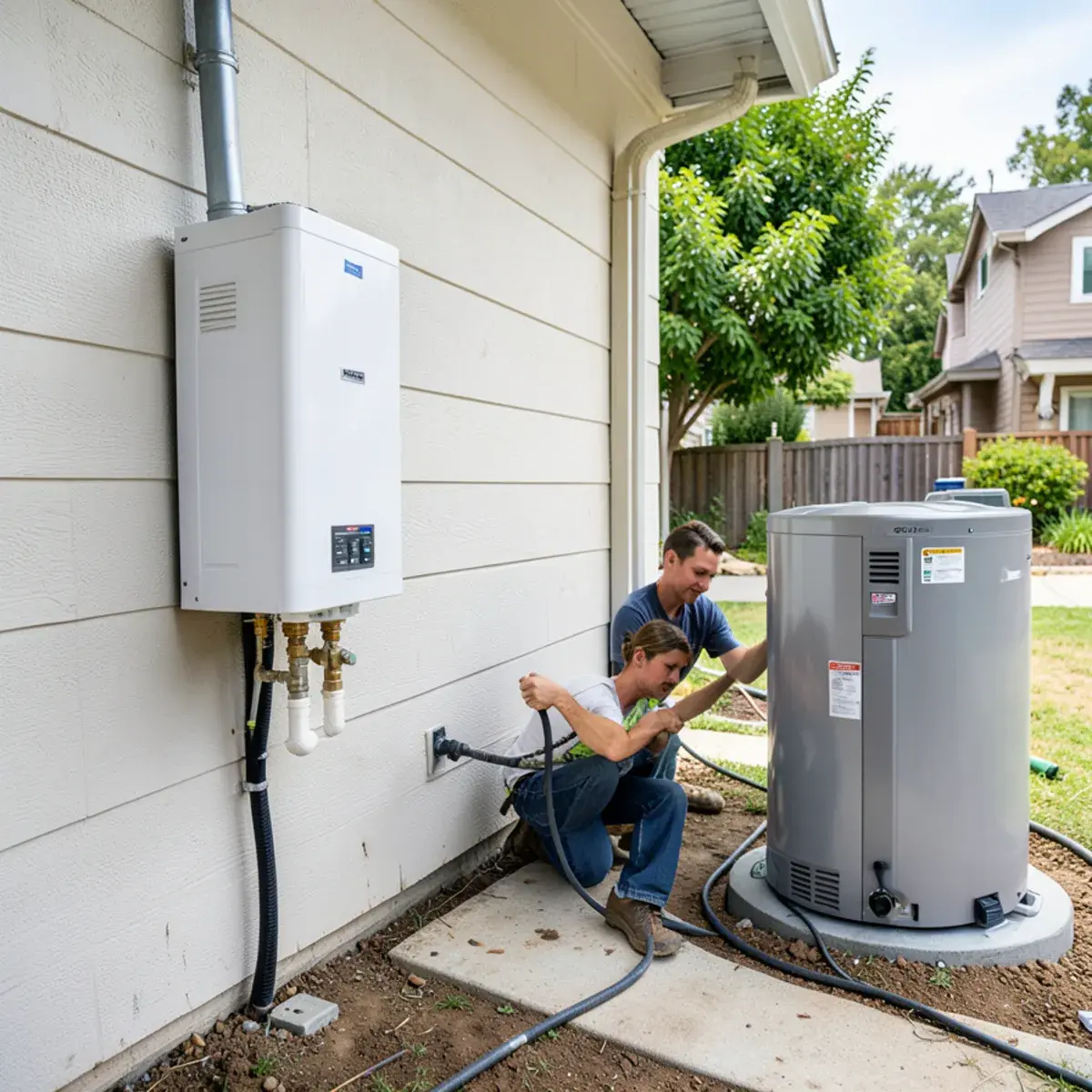
If you're replacing a water heater in East Contra Costa, the two efficient options most people compare are a gas tankless unit and a hybrid heat-pump water heater. They solve different problems. Tankless gives you continuous hot water and frees up floor space. A heat pump uses electricity very efficiently and fits where the Bay Area's appliance rules are heading. Neither wins for every home.
Here's a balanced comparison.
How Each One Works
A tankless water heater heats water only when you turn on a tap, using a powerful gas burner (or large electric elements) and a heat exchanger. There's no stored water, so it doesn't run out, but it's limited by how many gallons per minute it can heat at once.
A hybrid heat-pump water heater is a storage tank with a small heat pump on top. Instead of heating water directly, it moves heat from the surrounding air into the tank, like a refrigerator in reverse. It's typically several times more efficient than a standard electric tank, and it has backup electric elements for periods of heavy demand.
Side-by-Side
| Factor | Gas tankless | Hybrid heat pump |
|---|---|---|
| Fuel | Natural gas or propane | Electricity |
| Hot water supply | Continuous, limited by flow rate (GPM) | Stored (often 50–80 gallons), recovers slower |
| Space | Wall-mounted, small footprint | Floor-standing, needs room or ducted air |
| Installation needs | Large gas line, dedicated venting | 240V circuit for most models (some 120V), condensate drain |
| Typical lifespan | 20+ years with descaling | About 10–15 years |
| Maintenance | Annual descaling in hard water | Air filter cleaning, periodic tank flush, anode checks |
| Noise | Quiet fan when running | Compressor hum, similar to a refrigerator |
| Bay Area zero-NOx rule | Most whole-house units in the 2031 tier | Already compliant |
| Rebates | Limited | Often eligible for utility and state programs |
When Tankless Is the Better Fit
- High simultaneous demand. Large households running two or three showers at once, as long as the unit and gas line are sized for it.
- Limited floor space. A wall-mounted unit frees up garage or closet space.
- Long-term ownership. A well-maintained tankless unit often outlasts two tanks.
- You're replacing an existing tankless unit and the gas line and venting are already in place. See tankless water heater replacement.
When a Heat Pump Is the Better Fit
- You want the lowest operating energy. Heat pumps are among the most efficient water heaters available.
- You have a roomy garage. East County's hot summers and warm garages are good conditions for heat-pump efficiency, and the unit cools and dehumidifies the space slightly as a bonus.
- You're planning around electrification. With the Bay Area Air District's zero-NOx water heater rule, new residential gas tanks are on a timeline. A heat pump avoids that question entirely.
- You have solar. Running the heat pump during the day on solar power lowers operating cost further.
- You want rebates. Heat pumps are more likely to qualify; see our heat-pump rebate guide.
The Practical Constraints
The decision often comes down to your house, not the spec sheet.
For tankless, the gas line is the big question. Many East County homes have a ½-inch line to the water heater, sized for a tank. A whole-house tankless unit usually needs a larger line, sometimes a meter upgrade, plus new venting. That work can be the largest part of the job.
For a heat pump, it's space and electrical. The unit needs enough air around it (or ducting), a place to drain condensate, and usually a dedicated 240-volt circuit. If your panel is full, a 120-volt plug-in model or a panel evaluation may be needed.
What About Cold Climates and Winter?
Brentwood winters are mild, but a heat-pump unit in an unheated garage still runs a little less efficiently on cold mornings and may lean on its backup elements during heavy use. Tankless units deliver slightly fewer gallons per minute in winter because incoming water is colder. Neither is a dealbreaker here, but both are worth sizing for.
Our Take
If you have a gas tankless unit that's served you well and the gas line and venting are already sized for it, replacing like-for-like is usually simplest. If you're replacing a gas tank in a roomy garage and your panel has capacity, a heat pump is usually the more forward-looking choice. If you have very high simultaneous demand and limited space, tankless often fits better.
We install both, so we don't have a reason to push one. During a free assessment we check your gas line, panel, space, and hot-water demand, then recommend what fits. Learn more about tankless installation and hybrid heat-pump installation.
Frequently Asked Questions
Is a heat pump water heater better than tankless?
Neither is better for every home. Heat pumps use less energy and fit the Bay Area's electrification rules; tankless units provide continuous hot water, take less space, and often last longer. The right choice depends on your space, electrical panel, gas line, and hot-water demand.
Which lasts longer, tankless or heat pump?
A well-maintained tankless water heater commonly lasts 20 years or more. Hybrid heat-pump water heaters typically last about 10 to 15 years, similar to a tank.
Can a heat pump water heater keep up with a large family?
Yes, if it's sized properly. Larger households often choose a 65- to 80-gallon heat-pump unit, and most have a high-demand mode that uses the backup elements to recover faster.
Do heat pump water heaters work in a garage?
Garages are often the best location in East Contra Costa, because they're warm for much of the year and have the space and air volume the unit needs.
Need help from a licensed Brentwood plumber?
We provide free on-site assessments and upfront quotes — and we pull the permit and handle the city inspection for you.