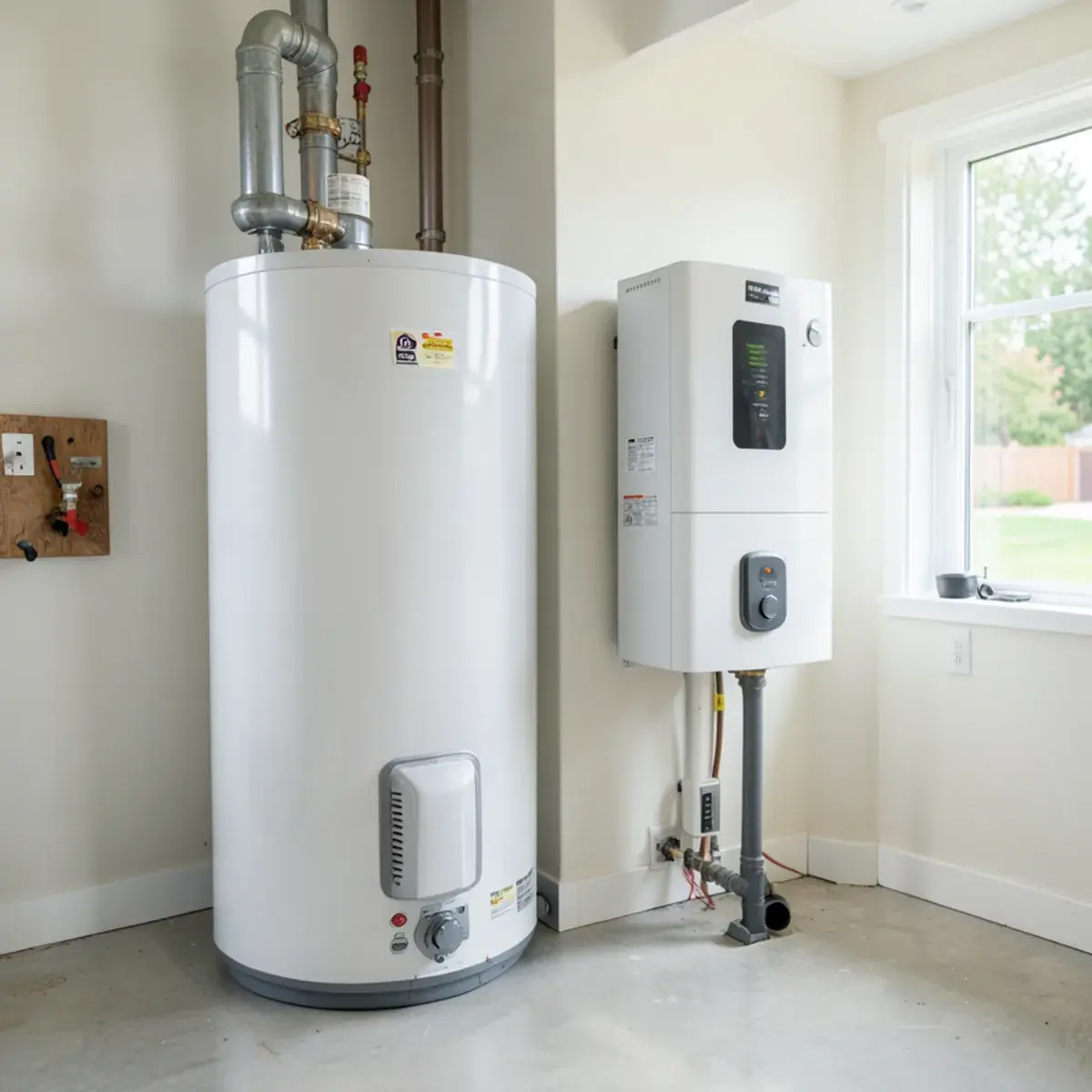
"Should I go tankless?" is the question we hear most from Brentwood homeowners replacing an aging water heater. It's a genuinely good question, because the right answer changes the next 10–20 years of your hot water, your energy bills, and your maintenance routine. There's no universal winner — there's a winner for your home. This guide compares tankless vs. tank water heaters on the things that actually matter so you can decide with confidence.
The Core Difference
A conventional tank water heater keeps 40–80 gallons of water hot around the clock, ready whenever you open a tap. A tankless (or "on-demand") unit heats water only as it flows through, giving you a continuous supply with no stored reserve. That single design difference cascades into every other trade-off below.
Upfront Cost
The tank wins here, plainly. A tank water heater installation costs less for both the unit and the labor — it's usually a straightforward swap. A tankless installation costs more up front because the unit is pricier and the job often involves upsizing the gas line, adding dedicated venting, and running electrical. If your only concern is the lowest possible install-day number, tank wins.
Operating Cost and Efficiency
Tankless pulls ahead over time. Because it isn't reheating a stored tank all day (so-called "standby loss"), a tankless unit is meaningfully more efficient, especially in households with moderate hot-water use. A high-efficiency hybrid heat-pump tank is the efficiency champion of all, often using a fraction of the energy of a standard electric tank — worth a look if you have the space and a warmer install location like a garage.
Lifespan
Tankless typically lasts longer — often 18–20+ years with maintenance, versus roughly 8–12 for a tank. That longer life is part of how the higher upfront cost pays back. But there's a hard-water asterisk on that number, which brings us to the most important local factor.
The Brentwood Hard-Water Factor
Brentwood has hard water, and hard water is tough on both types — but it punishes tankless units faster if they're neglected. Minerals form scale inside the tankless heat exchanger, choking flow and efficiency. The fix is simple and routine: an annual tankless descaling. Tanks suffer too, accumulating sediment that needs an annual flush. Many homeowners protect either type with a whole-house water softener. The takeaway: tankless rewards maintenance and penalizes neglect more than a tank does.
Space and Hot-Water Demand
Tankless units mount on a wall and free up floor space — a real perk in a garage or utility closet. They also deliver endless hot water, so back-to-back showers never run cold. The catch is flow capacity: a single tankless unit is sized in gallons per minute (GPM), and a large household running multiple fixtures at once may need a larger unit or two units. A tank, by contrast, delivers strong simultaneous flow until it's drained, then needs recovery time. Our sizing guide covers GPM math for tankless and gallon sizing for tanks.
Quick Comparison
| Factor | Tank | Tankless |
|---|---|---|
| Upfront cost | Lower | Higher |
| Energy efficiency | Good | Better |
| Lifespan | ~8–12 years | ~18–20+ years |
| Space | Takes floor space | Wall-mounted, compact |
| Simultaneous demand | Strong until drained | Endless, limited by GPM |
| Hard-water maintenance | Annual flush | Annual descaling |
So Which Should You Choose?
Choose a tank if you want the lowest upfront cost, have high simultaneous demand, or want the simplest possible swap. Choose tankless if you value endless hot water, lower long-term bills, a longer lifespan, and recovered floor space — and you'll commit to annual descaling. For many Brentwood homes, a tank-to-tankless conversion is worth it; we lay out the honest math in Is a Tankless Water Heater Worth It?.
Considering a heat pump instead? See heat pump vs. tankless water heaters.
Frequently Asked Questions
Is tankless always more efficient than a tank?
It's generally more efficient because it eliminates standby heat loss from a stored tank. The exact savings depend on your household's hot-water habits — homes with moderate, spread-out usage tend to see the biggest gains. A hybrid heat-pump tank can rival or beat tankless on efficiency.
Does a tankless water heater really provide endless hot water?
Yes, within its flow capacity. It heats water continuously as it passes through, so you won't run out mid-shower. The limit is GPM: running many hot taps at once can exceed a single unit's capacity, which is why correct sizing matters.
Why does hard water matter more for tankless units?
Hard water deposits scale inside a tankless heat exchanger, which reduces flow and efficiency if ignored. An annual descaling clears it. Tanks also need an annual flush, but tankless units are less forgiving of skipped maintenance.
Is converting from a tank to tankless worth the extra cost?
For many homes, yes — over its longer lifespan a tankless unit can offset its higher install cost through energy savings and not needing replacement as soon. We'll give you an honest assessment of the payback for your specific home before you commit.
Need help from a licensed Brentwood plumber?
We provide free on-site assessments and upfront quotes — and we pull the permit and handle the city inspection for you.