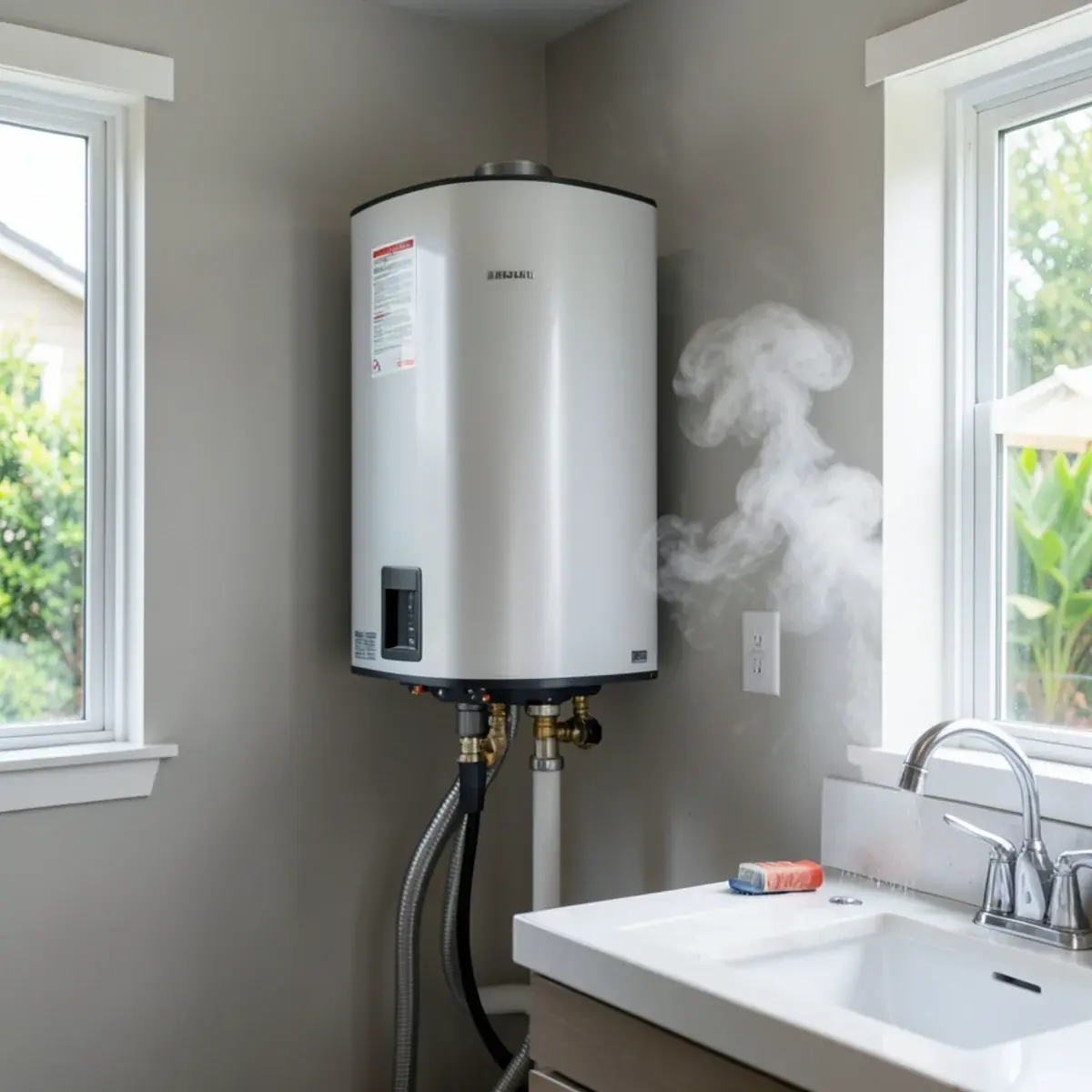
Tankless water heaters get a lot of hype — endless hot water, lower bills, decades of service. But they also cost more up front, and the honest answer to "is it worth it?" is: for many Brentwood homes, yes — with a couple of real caveats. Here's a straight look at the pros, the cons, and the actual savings.
The Case For Tankless
Endless hot water. A tankless unit heats on demand, so back-to-back showers never run cold within its flow capacity.
Lower energy bills. With no stored tank to keep hot around the clock, you eliminate standby loss. Most homes see a meaningful efficiency gain, especially with moderate, spread-out usage.
Longer lifespan. Tankless units often last 18–20+ years versus 8–12 for a tank — so the higher upfront cost amortizes over a longer life.
Space savings. Wall-mounted units free up floor space in the garage or closet.
The Case Against (Be Honest)
Higher upfront cost. Both the unit and the install cost more, often because of gas-line upsizing, new venting, and electrical work — covered in our cost guide.
Flow limits. A single unit is sized in GPM. A large household running several fixtures at once may need a bigger unit or two — see our sizing guide.
The hard-water catch. This is the big one in Brentwood. Tankless heat exchangers scale up in hard water and must be descaled annually to protect performance and warranty. Skip it and you lose the efficiency you paid for.
Do the Savings Add Up?
The payback math depends on your usage, your current unit, and energy rates. A household replacing an old, inefficient tank and committing to annual descaling typically comes out ahead over the unit's lifetime, thanks to lower bills and a longer replacement cycle. A home with very high simultaneous demand and no interest in maintenance may be better served by a high-efficiency hybrid heat-pump tank instead. We'll give you the honest payback estimate for your home — no pressure either way.
Who Tankless Is Not Right For
Tankless isn't the answer for every home, and a contractor worth trusting will tell you so. If your household runs several hot taps at once — multiple showers plus a dishwasher and laundry during the same busy hour — a single unit can hit its flow ceiling, and the fix (a larger unit or two units) erodes the savings. If you have no appetite for annual descaling, Brentwood's hard water will quietly steal the efficiency you paid for. And if you're simply replacing a failed tank on a tight budget and plan to move in a few years, you may never recoup the higher upfront cost.
In those cases a high-efficiency tank or a hybrid heat-pump unit is often the smarter buy. The point isn't that tankless is bad — it's that "worth it" depends on your home, not on the marketing.
If you're also considering an electric option, our heat pump vs. tankless comparison lays out the trade-offs side by side.
Frequently Asked Questions
Is a tankless water heater worth the extra cost?
For many homes, yes. The higher upfront cost is offset over the unit's longer lifespan through lower energy bills and a delayed replacement, provided you keep up with annual descaling in hard-water areas like Brentwood.
How much can a tankless water heater save on energy?
Savings vary by household and energy rates, but eliminating standby heat loss makes tankless meaningfully more efficient, with the biggest gains in homes with moderate, spread-out hot-water use.
What's the downside of going tankless?
Higher upfront cost, flow-rate limits that can require a larger or second unit for high simultaneous demand, and the need for annual descaling to manage hard-water scale.
Is tankless or a heat-pump water heater more efficient?
Both are efficient. Hybrid heat-pump tanks can rival or exceed tankless efficiency and avoid GPM flow limits, but they need space and a suitable warmer location. The best choice depends on your home.
Need help from a licensed Brentwood plumber?
We provide free on-site assessments and upfront quotes — and we pull the permit and handle the city inspection for you.