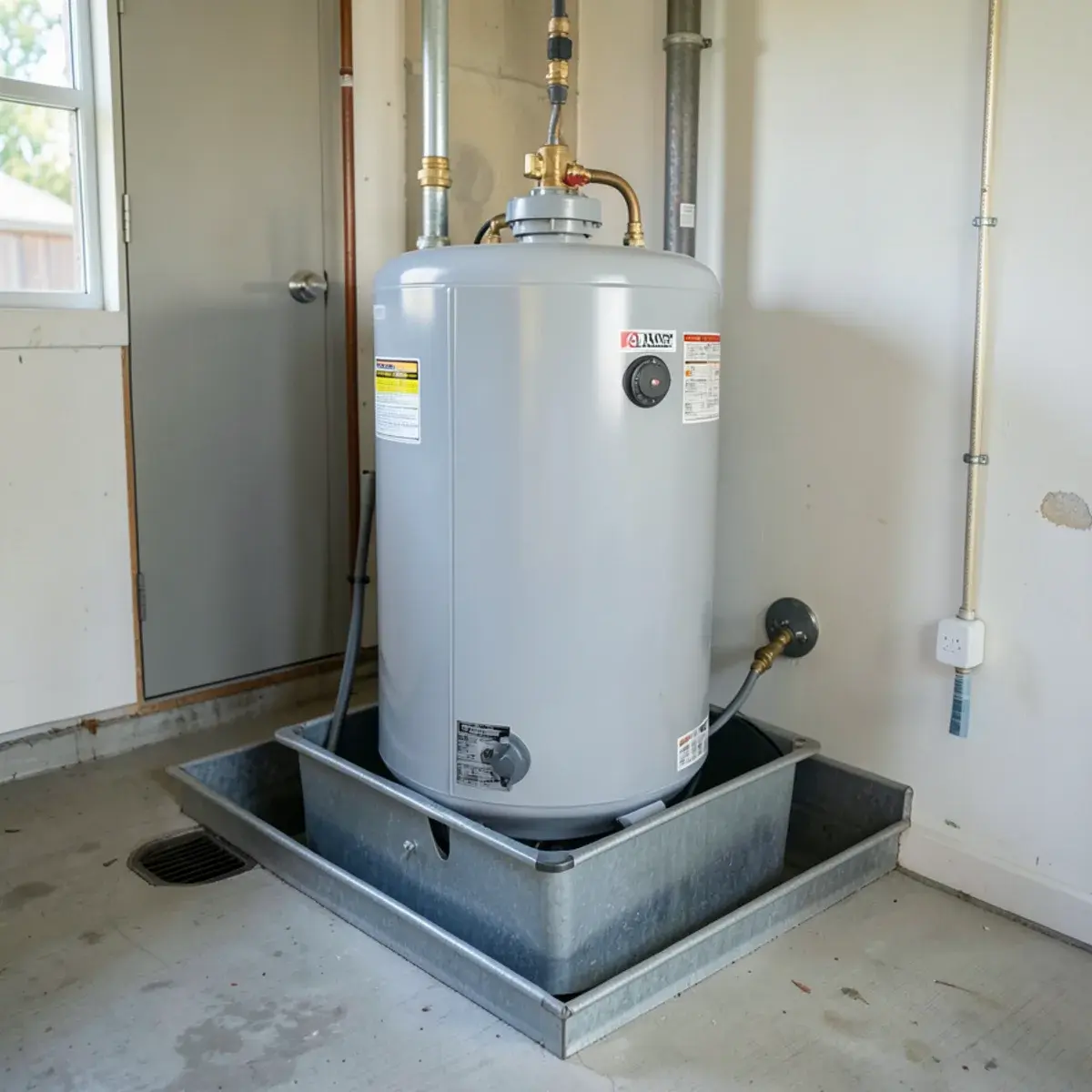
Is a water heater drain pan required by code? In California, it depends on where the water heater is installed. If a leak would damage the building, such as an attic, an upstairs closet, or a utility room over finished space, the plumbing code requires a pan. A tank sitting on a concrete garage slab usually doesn't need one. This guide covers exactly when a pan is required, what the pan and its drain must look like, and the mistakes that fail inspections.
When a Drain Pan Is Required
The California Plumbing Code requires a watertight pan under a water heater installed:
- In an attic, or in an attic-ceiling assembly
- On a floor-ceiling assembly, meaning any floor with living space or a finished ceiling below it, like a second-story closet
- On a floor-subfloor assembly where a leak would cause damage, such as an interior utility room or hall closet on a wood floor
The common thread is damage. A tank failure in an attic or upstairs closet can flood ceilings, walls, and rooms below in minutes. The pan catches that water and carries it somewhere safe.
When a Drain Pan Usually Isn't Required
A water heater on a concrete slab in a garage typically doesn't require a pan, because a leak runs across the slab and out the garage door instead of into the structure. Many installers still recommend one when:
- The heater sits on a raised wooden platform
- Boxes, tools, or a finished wall are right beside it
- The garage floor slopes toward the house
- The heater is in a converted garage or living space
Your local inspector has the final say, so if your installation is borderline, ask before the work starts.
What the Pan Has to Look Like
When a pan is required, the code is specific:
| Requirement | What it means |
|---|---|
| Material | Watertight and corrosion-resistant, such as galvanized steel, aluminum, or an approved plastic |
| Depth | At least 1½ inches deep |
| Size | Wide enough to catch water from the whole tank, typically a few inches wider than the heater |
| Drain | At least ¾ inch in diameter |
| Drain termination | Piped to an approved location, not left to fill up |
Plastic pans must be rated for the application. Gas water heaters generally need a metal pan, or a plastic pan listed for use under gas appliances, because of heat near the burner.
Where the Drain Line Can Go
The pan's drain has to end somewhere water can go safely. Acceptable locations generally include:
- An indirect waste receptor, like a floor sink or standpipe with an air gap
- The exterior of the building, terminating 6 to 24 inches above grade where it's visible
- Another approved location your local building department accepts
A pan with no drain, or a drain that dead-ends in the attic, defeats the purpose. That's one of the most common things inspectors flag.
The Pan Drain Is Not the Relief-Valve Drain
These are two separate lines:
- The TPR valve discharge line carries hot water and steam from the relief valve. It has its own rules: full size, no cap, and termination 6 to 24 inches above the floor or to an approved location.
- The pan drain carries leaking water from the pan.
On some installations the relief line may discharge into the pan, but only if the pan drain can handle that flow and your local code allows it. When in doubt, keep them separate. Our California water heater code guide covers the TPR line in more detail.
Common Drain Pan Mistakes
- No drain line at all. The pan fills and overflows during the leak it was meant to catch.
- An undersized drain, smaller than ¾ inch, or one that's kinked or uphill.
- A pan too small for the heater's footprint.
- A plastic pan under a gas heater that isn't listed for it.
- A drain that ends inside the attic or in a wall cavity.
Do Tankless and Heat-Pump Water Heaters Need Pans?
Tankless units don't store water, but they can still leak at fittings or the heat exchanger. Pan requirements for wall-mounted units vary, so follow the manufacturer's instructions and your inspector. Condensing tankless units also need a condensate drain, which is separate from any pan.
Heat-pump water heaters are storage tanks, so the same location rules apply. They also produce condensate that must drain to an approved location, which we plan alongside the pan drain on hybrid heat-pump installations.
What This Means for East County Homes
Most water heaters in Brentwood's newer tract homes sit on garage slabs and don't need a pan. Pans come up most in:
- Interior closet installs in older Concord, Pleasant Hill, and Pittsburg homes
- Utility rooms in Discovery Bay waterfront homes
- Second-floor or attic installs in some larger homes
Every water heater installation and replacement we do includes a pan when the location calls for one, and the permit inspection confirms it.
Frequently Asked Questions
Is a water heater pan required by code in California?
Yes, when the water heater is in an attic or on a floor or ceiling assembly where a leak would damage the building. The pan must be at least 1½ inches deep, corrosion-resistant, and drained through a pipe at least ¾ inch in diameter to an approved location.
Does a water heater in a garage need a drain pan?
Usually not when it sits on a concrete garage slab. A pan is still a good idea if the heater is on a wooden platform or near stored items or a finished wall.
How deep does a water heater drain pan need to be?
At least 1½ inches deep, with a drain of at least ¾ inch.
Can the relief valve drain into the drain pan?
Sometimes, but only where local code allows it and the pan drain can handle the flow. Keeping the TPR discharge line and the pan drain separate is the safer default.
Do I need a metal pan for a gas water heater?
Generally yes, or a plastic pan specifically listed for use under gas water heaters, because of the heat near the burner.
Need help from a licensed Brentwood plumber?
We provide free on-site assessments and upfront quotes — and we pull the permit and handle the city inspection for you.